The short answer
The best aftercare plan is the written plan from the clinician who performed your treatment. It should identify permitted products, expected reactions, activity guidance, restart instructions and a contact for problems. Generic timelines cannot account for every device or treatment intensity.
By Microneedling Resource · Updated September 27, 2026 · AI-assisted research and writing. This educational page has not been medically reviewed.
On this page · Make recovery simpler · Expected reactions need a trend · Returning to normal products · Choose the right companion reference · Your written aftercare plan · Keep researching · Sources & evidence notes
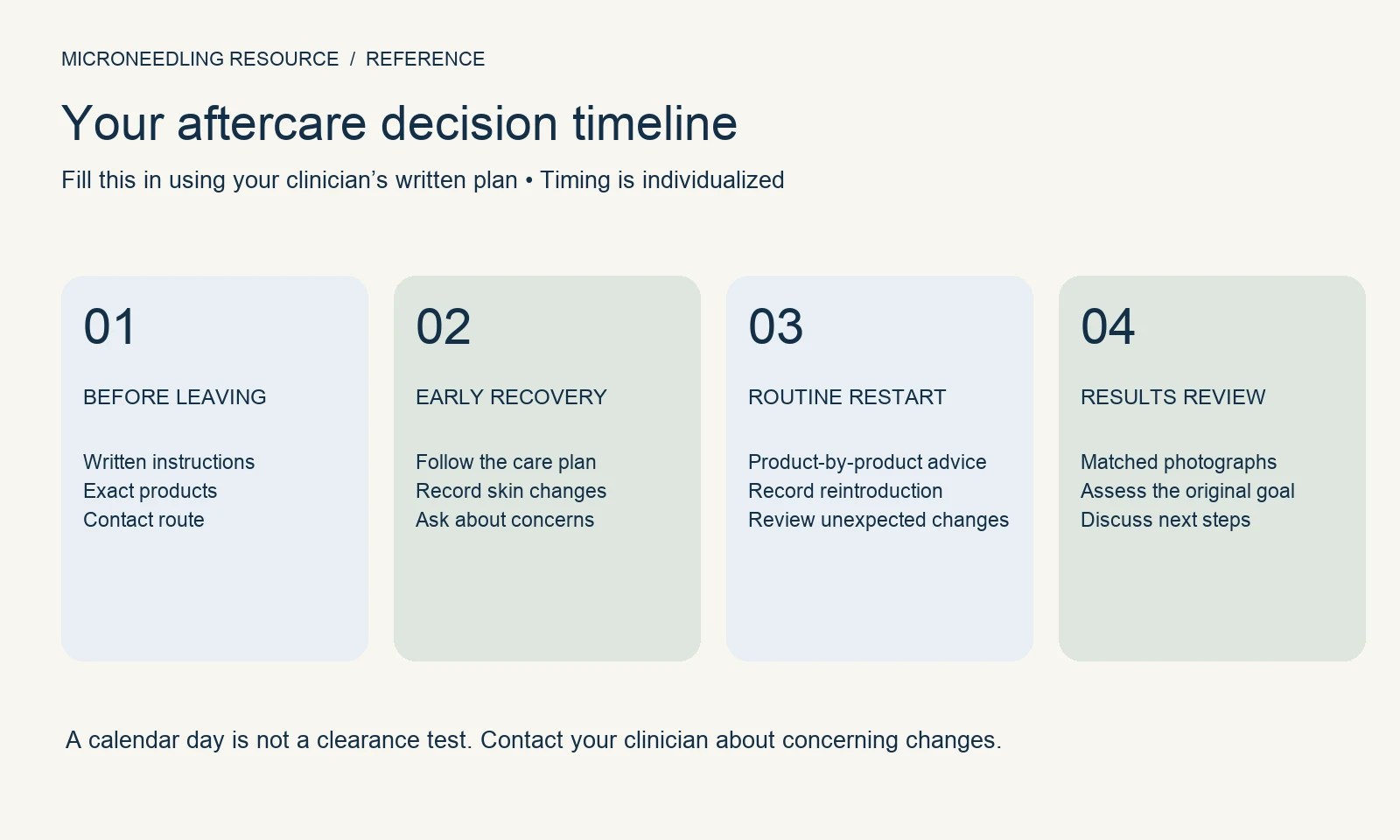
| Before leaving | What to write down |
|---|---|
| Cleansing | Exact product and when to start |
| Moisturizing | Which formulation and how to use it |
| Sun protection | Practical protection and product timing |
| Makeup and actives | What to pause and conditions for resumption |
| Activities | Any procedure-specific restrictions |
| Escalation | Expected course, warning signs and contact details |
Make recovery simpler
Avoid introducing several new products at once. Keep the instructions and the products together so you are not reconstructing the plan from memory. If the plan conflicts with an existing prescription, ask the treating clinician to reconcile it. Do not substitute a product simply because the front label mentions the same ingredient.
Expected reactions need a trend
The FDA describes redness, discomfort, dryness and other reactions after treatment. What matters is whether your experience follows the course explained by your provider. A symptom that is worsening or different from the expected pattern deserves attention; a calendar alone cannot establish that everything is normal.
When to get help
Contact a healthcare professional for worsening pain, spreading redness, pus, fever or other unexpected symptoms. Seek urgent assessment for severe or rapidly progressing symptoms. Do not use this page to diagnose a complication.
Returning to normal products
Ask for specific instructions for retinoids, exfoliants and other actives. Your usual tolerance on intact skin does not establish tolerance during recovery. If you are unsure whether a product is part of the plan, clarify before applying it.
Choose the right companion reference
Use the recovery guide to interpret the distinction between symptoms and later results. Use the aftercare timeline as a compact action list. Use the product-category guide for questions about what to apply.
Your written aftercare plan
Use this worksheet at the appointment so that advice does not depend on memory. Leave space for individualized instructions. The purpose is to record the clinician’s plan, including what to do when something unexpected happens.
| Record or decision | What to write down |
|---|---|
| Products | Exact product names and instructions. |
| Activities | Any temporary restrictions and their duration. |
| Expected recovery | What changes the provider expects for this procedure. |
| Escalation | Symptoms that should prompt contact or urgent care. |
| Contact | Daytime and out-of-hours contact route. |
What if the clinic’s advice differs from this guide?
Ask the treating clinician to explain the difference in relation to the exact procedure and your history. This page organizes questions; it does not replace individualized instructions or advise you to ignore a concerning change.
Keep researching
- Microneedling Healing & Recovery Timeline
- What Should You Put on Your Skin After Microneedling?
- Microneedling Aftercare Timeline
- What Ingredients Should You Avoid With Microneedling?
- Microneedling Side Effects, Risks & Contraindications
Sources & evidence notes
- FDA: Benefits, risks and safety
- FDA: Microneedling devices
- American Academy of Dermatology: Microneedling
Sources checked September 27, 2026. Linked regulatory and research sources describe their own populations and procedures; they do not establish that every commercial device or serum is equivalent.

