The short answer
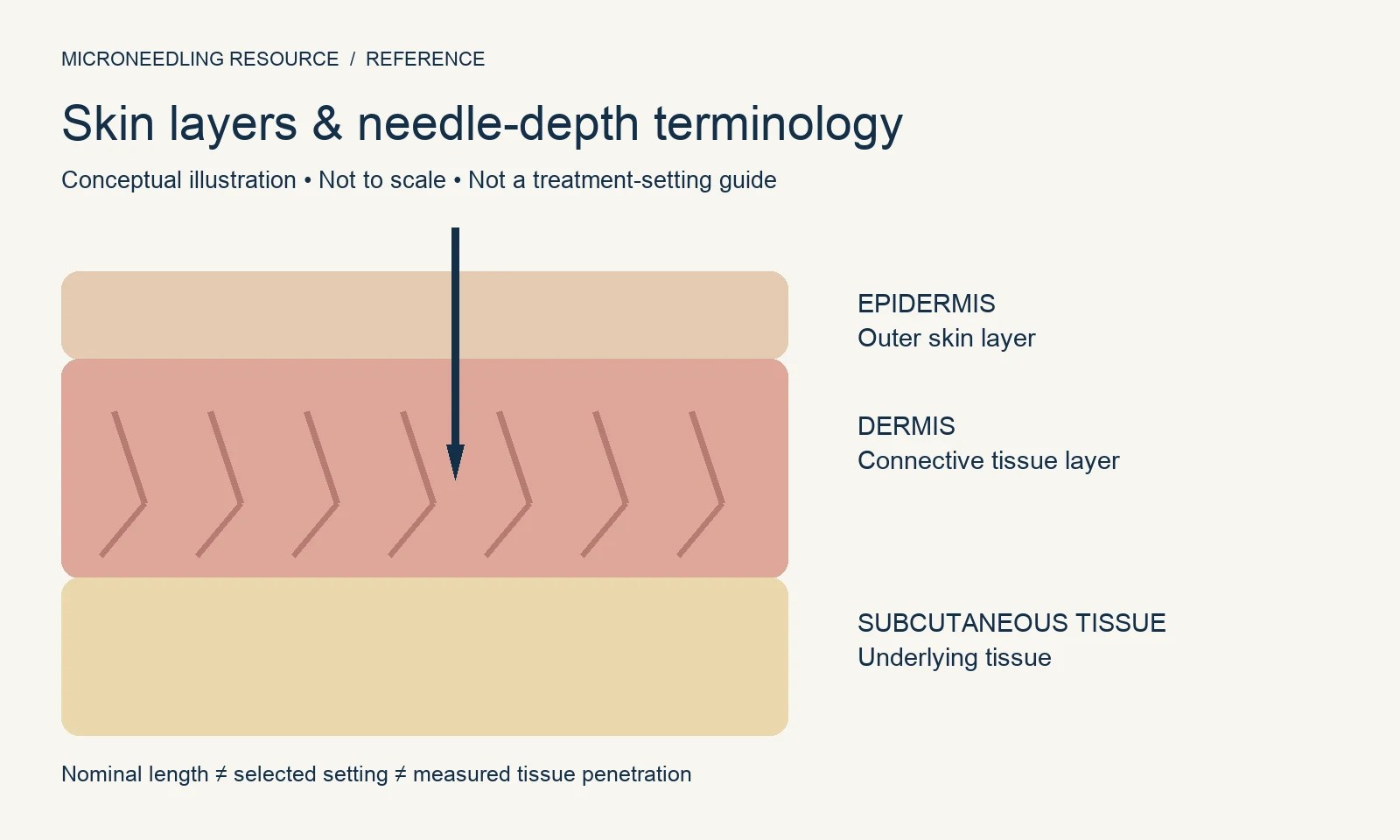
There is no universally safe home microneedling depth that can be selected from a face chart. A displayed setting does not capture actual penetration, skin variation, device design, pressure or medical suitability.
By Microneedling Resource · Updated September 27, 2026 · AI-assisted research and writing. This educational page has not been medically reviewed.
On this page · What the depth dial tells you · Information to bring to a consultation · Audit a depth-chart claim · Keep researching · Sources & evidence notes
| Common assumption | What it leaves out |
|---|---|
| A small number means cosmetic use | Intended use and whether living skin is penetrated still matter |
| A setting equals actual tissue penetration | Device mechanics, contact and tissue vary |
| A face map works for everyone | Skin thickness, scarring and individual risk are not uniform |
| No bleeding means no risk | Visible bleeding is not a validated safety test |
| A published clinical depth is a home recommendation | Training, selection and care differ |
What the depth dial tells you
The dial is a device control described by that manufacturer. It does not independently prove a particular tissue exposure or establish suitability for a body area. Use the master depth reference to understand the concepts; ask a qualified provider about a treatment plan.
Do not escalate to chase results
If a cosmetic tool does not produce a clinical-treatment result, increasing penetration is not a justified next step. Reassess the goal and product category.
Information to bring to a consultation
Record the exact product and model, the manufacturer’s labeling, the area you want to treat and the concern. Tell the clinician about prior pigment changes or unusual healing. These details are more useful than asking for one number that supposedly fits every device.
Audit a depth-chart claim
When you see a depth chart, record the source and what the numbers refer to. A chart is less useful when it hides the device, treatment goal or population. Do not copy a number from a diagram into a device setting.
| Record or decision | What to write down |
|---|---|
| Source | Who produced the chart and what evidence is cited? |
| Device | Which exact device or needle geometry? |
| Meaning | Nominal needle length, selected setting or measured penetration? |
| Context | What body area and clinical purpose? |
| Boundary | Does the chart acknowledge individual variation? |
Can I use a shallow setting to make any pen cosmetic?
A numerical setting alone does not establish the device’s intended use or its suitability for you. Evaluate the complete product and instructions. Changing a dial does not turn professional documentation into consumer instructions.
Keep researching
- Microneedling Needle Depth Chart & Reference Guide
- Microneedling at Home: Complete Guide
- Best At-Home Microneedling Pens: Evidence & Buyer Checks
- Microneedling Side Effects, Risks & Contraindications
Sources & evidence notes
Sources checked September 27, 2026. Linked regulatory and research sources describe their own populations and procedures; they do not establish that every commercial device or serum is equivalent.

