The short answer
A needle-depth chart should help you interpret terminology, not prescribe a number for each part of your face. Needle length, device setting and actual tissue penetration are different concepts. Individual treatment settings belong in a clinician’s plan.
By Microneedling Resource · Updated September 27, 2026 · AI-assisted research and writing. This educational page has not been medically reviewed.
On this page · Conceptual skin-layer reference · Why we do not publish a universal face-depth recipe · A better way to read a study · Bring the reference to your consultation · Use a depth reference without turning it into a prescription · Keep researching · Sources & evidence notes
| Reference term | What it describes | What it does not establish |
|---|---|---|
| Nominal needle length | Physical dimension described by the manufacturer | Actual penetration in a particular person |
| Displayed depth setting | A manufacturer-defined device adjustment | A universal depth across different devices |
| Actual penetration | Interaction of device, contact and tissue | A value known from the dial alone |
| Published study depth | A parameter within one study protocol | A home recommendation or transferable treatment plan |
| Clinical selection | Decision based on device, indication and person | A rule that can be reduced to a face map |
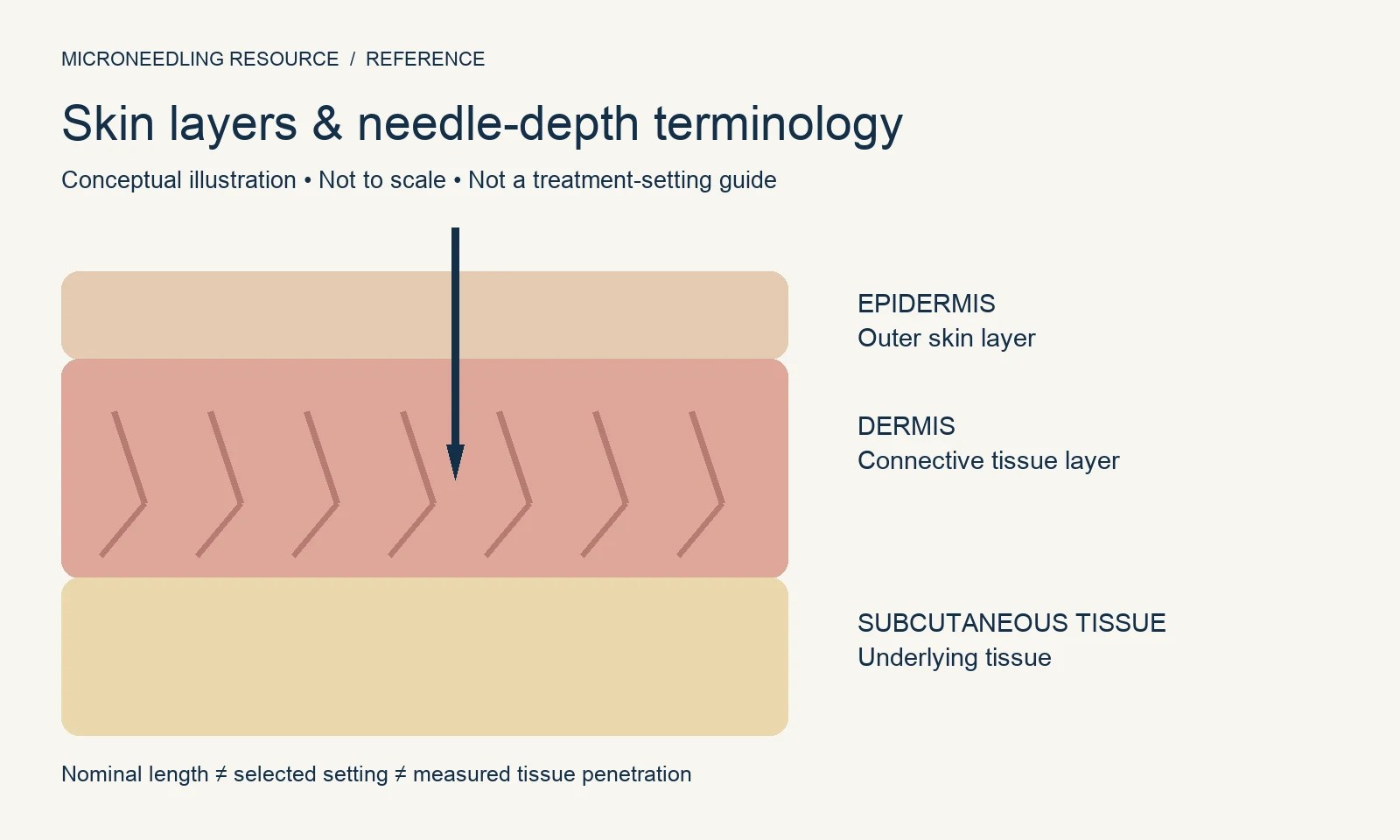
Conceptual skin-layer reference
Surface barrier
The outer barrier is the first boundary relevant to topical exposure. “Surface cosmetic use” and penetration into living tissue are different contexts.
Living skin and deeper tissue
Depth changes the structures potentially reached. Device design, anatomy and clinical technique matter; this conceptual diagram is intentionally not to scale.
Why we do not publish a universal face-depth recipe
A numeric table can look authoritative while omitting tissue variation, device mechanics, contraindications and operator training. Published research reports a range of protocols for selected patients. The correct use of those data is clinical interpretation, not copying the deepest reported setting.
A better way to read a study
Record the device, needle specification, body area, patient population, intervention, number of sessions and outcome. Keep these details together. If a commercial chart cites a study but omits the device or condition, its practical meaning is incomplete.
A depth setting is not a safety certificate
The absence of visible bleeding, a short needle or a familiar-looking device does not establish that a procedure is suitable for home use.
Bring the reference to your consultation
Ask the provider how settings are selected for the exact device and concern, what evidence supports the proposed treatment and how risk is assessed. Do not request a number in isolation.
Use a depth reference without turning it into a prescription
The useful role of a depth chart is to clarify terminology and questions. A numerical setting is only one part of a treatment description. Record what the source actually means by depth before comparing studies or devices.
| Record or decision | What to write down |
|---|---|
| Nominal length | The physical length or specification described. |
| Selected setting | The device control chosen by the operator. |
| Tissue exposure | What happens in the tissue under the actual conditions. |
| Clinical choice | The provider’s judgment for the goal and site. |
| Evidence | The procedure and population described in the source. |
Why is there no universal face map of settings?
Such a map would conceal device differences, skin variation and the individualized treatment decision. The reference explains the variables rather than presenting one number as suitable for every reader.
Keep researching
- At-Home Microneedling Needle Depth Guide
- Microneedling Pen Guide
- Microneedling Cartridge & Needle Guide
- Microneedling Side Effects, Risks & Contraindications
Sources & evidence notes
- FDA: Microneedling devices
- FDA: Benefits, risks and safety
- Systematic review: potential adverse effects
Sources checked September 27, 2026. Linked regulatory and research sources describe their own populations and procedures; they do not establish that every commercial device or serum is equivalent.

