The short answer
A microneedling pen is a device format, not a quality or safety guarantee. Evaluate the exact model, intended use, user audience, cartridge system and documentation. Keep mechanical and radiofrequency devices in separate categories.
By Microneedling Resource · Updated September 27, 2026 · AI-assisted research and writing. This educational page has not been medically reviewed.
On this page · The label is more important than a feature count · Compare ownership costs accurately · Questions for a provider · Read a pen specification sheet · Keep researching · Sources & evidence notes
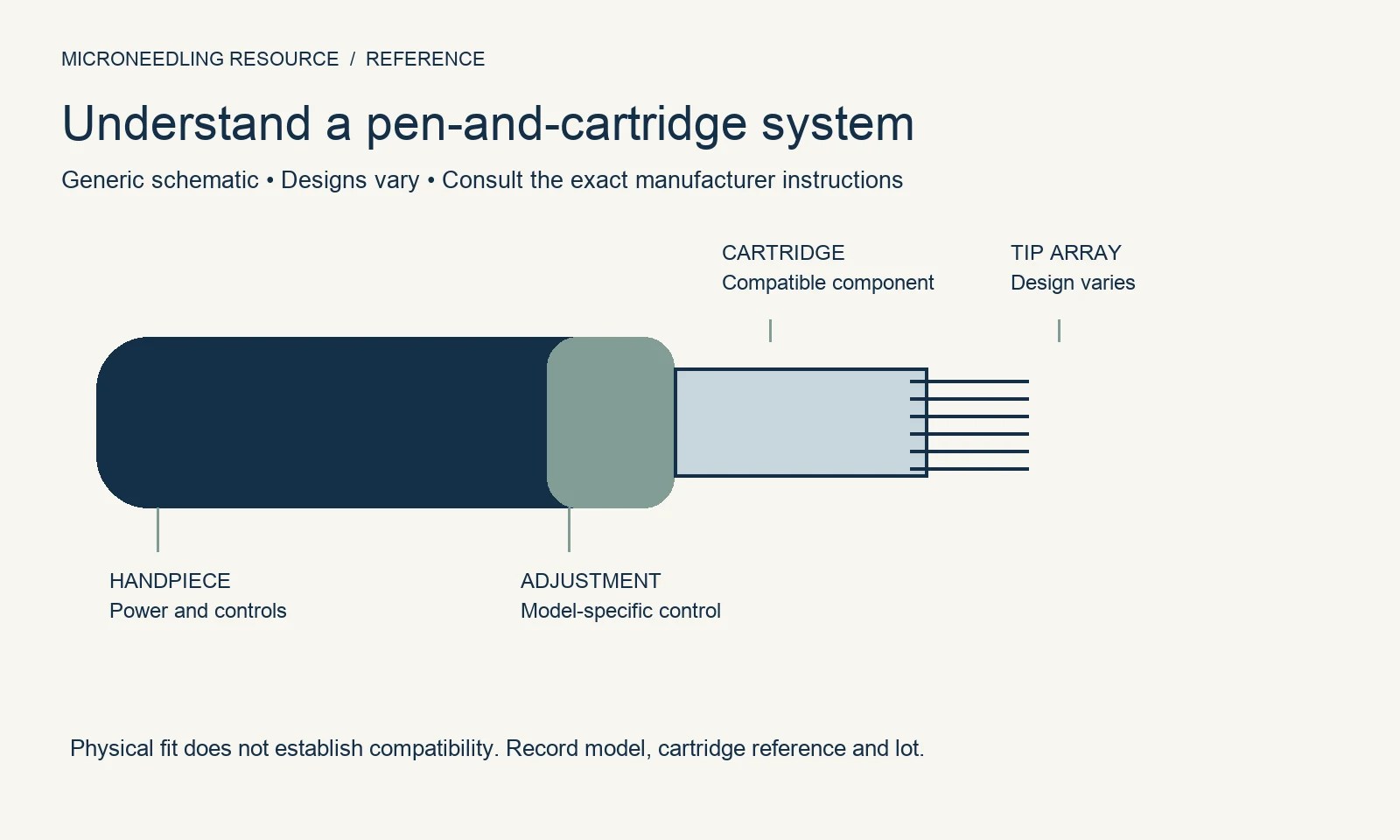
| Component | Function to understand | What to verify |
|---|---|---|
| Handpiece | Houses the mechanism and controls | Manufacturer, model and official instructions |
| Cartridge interface | Connects the treatment tip | Exact compatibility and authentic supply |
| Needle assembly | Contacts and may penetrate skin | Configuration, intended use and single-use labeling |
| Adjustment controls | Change manufacturer-defined settings | Meaning of each setting for this model |
| Power system | Operates the device | Approved power accessories and handling |
| RF energy system, if present | Adds energy delivery | Separate professional-use training and risk discussion |
The label is more important than a feature count
Compare what the manufacturer says the device is for, who should use it and in which market it is supplied. A larger depth range or higher speed does not establish superior clinical outcomes. Check the exact model against the regulatory record rather than a logo on a reseller listing.
Compare ownership costs accurately
Record the purchase price and current replacement-cartridge price separately. Include warranty, support and availability. If authentic compatible cartridges become difficult to obtain, an apparently inexpensive device can become unusable. Do not assume cartridges from a similar-looking pen are interchangeable.
Professional devices are not a home-use shortlist
The FDA has not authorized microneedling medical devices for over-the-counter sale. This reference explains devices and buying claims; it does not designate a penetrating pen for DIY use.
Questions for a provider
Which device will be used? What is its intended indication? Is the cartridge new for this session? How are reusable parts handled? What outcomes and adverse effects are relevant to the proposed treatment?
Read a pen specification sheet
Compare descriptions only when they refer to the same model and market. Marketing photographs can show a product family rather than the particular device being sold. Keep the original instructions alongside the comparison.
| Record or decision | What to write down |
|---|---|
| Identity | Manufacturer, model and market version. |
| Controls | What each control means according to the instructions. |
| Cartridge | Exact compatible system and authentic supply. |
| Power | Power format and labeled operating conditions. |
| Service | Support, warranty and replacement arrangements. |
Does a larger adjustment range mean a better device?
A broader range is a specification, not an outcome. Its relevance depends on intended use, control, documentation and the user’s training. It should not be used as a simple “more is better” score.
RF is a separate risk discussion
The FDA’s October 15, 2025 communication reports serious complications with certain RF microneedling uses, including burns, scarring, fat loss and nerve damage. It advises seeking trained licensed care and says RF devices should not be used at home. A mechanical pen comparison should not blur this distinction. Read FDA safety communication.
Keep researching
- Microneedling Cartridge & Needle Guide
- Nano vs Needle Microneedling Cartridges
- Best At-Home Microneedling Pens: Evidence & Buyer Checks
- Microneedling Needle Depth Chart & Reference Guide
Sources & evidence notes
- FDA: Microneedling devices
- FDA: Benefits, risks and safety
- FDA: Radiofrequency microneedling safety communication
Sources checked September 27, 2026. Linked regulatory and research sources describe their own populations and procedures; they do not establish that every commercial device or serum is equivalent.

