The short answer
Evaluate a serum as a finished product for a specific use. A strong evaluation records both verified facts and unknowns, and stops short of a recommendation when intended use or essential documentation is unclear.
By Microneedling Resource · Updated September 27, 2026 · AI-assisted research and writing. This educational page has not been medically reviewed.
On this page · Use gates before scores · How to handle unknown information · Calculate value honestly · Use the standards as evidence gates · Keep researching · Sources & evidence notes
| Standard | Evidence to request | Record as |
|---|---|---|
| Identity | Exact product, region, current INCI and batch | Verified / unclear |
| Intended use | Manufacturer directions and route | Topical routine / aftercare / other |
| Handling | Single-use or multi-use; storage and expiry | Documented / missing |
| Quality claims | Finished-product testing and traceability supporting the claim | Supported / manufacturer claim / unknown |
| Compatibility | Specific instructions relevant to the procedure | Established / not established |
| Formula context | Fragrance, colorants, actives and disclosed pH | Present / absent / not disclosed |
| Value | Current volume, price and assumptions | Comparable / not comparable |
Use gates before scores
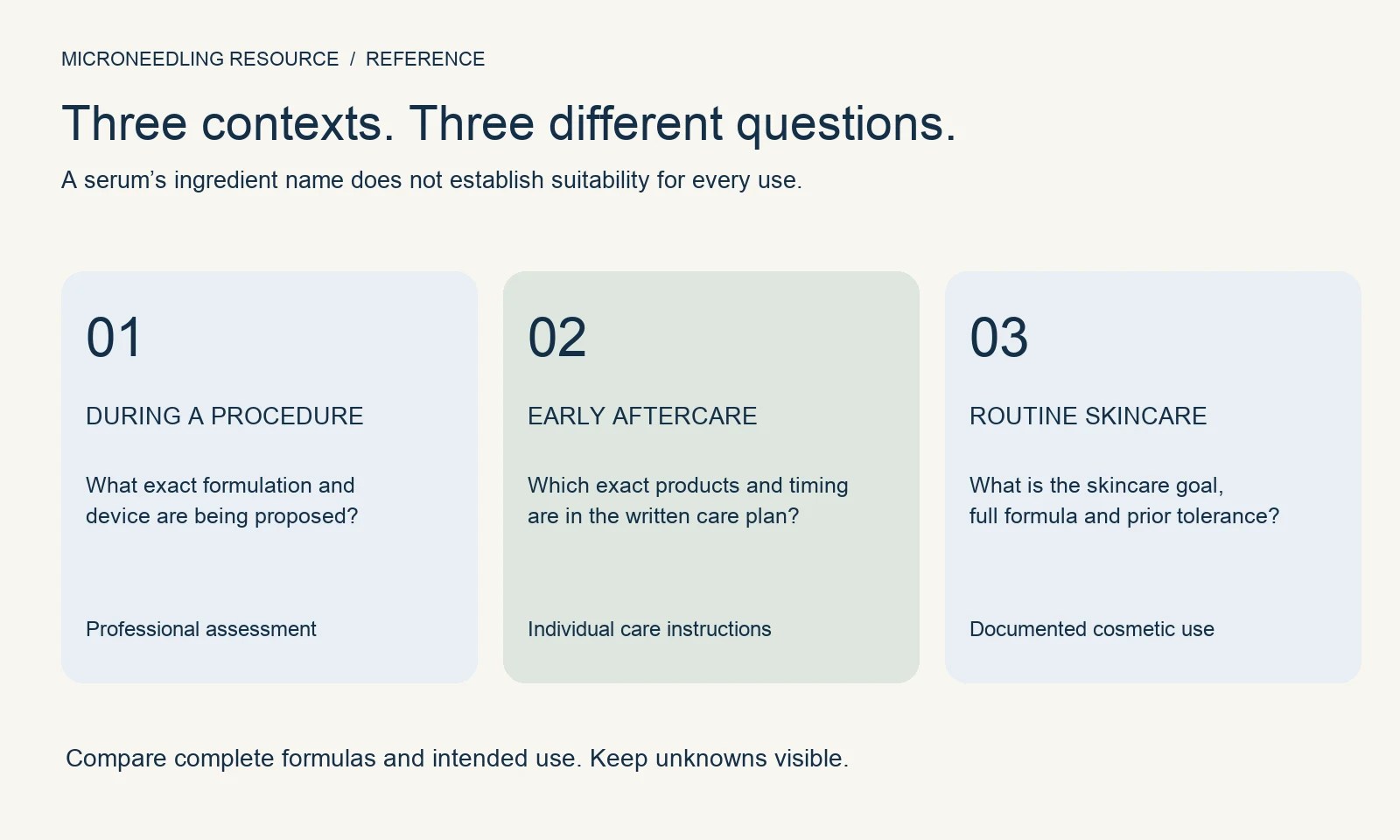
First establish the product’s identity and intended use. Next evaluate whether its evidence matches the claim. Only then compare convenience or cost. Do not allow a low price or attractive ingredient list to compensate for uncertainty about route or suitability.
How to handle unknown information
Write “not disclosed in the checked source” when pH, testing or a packaging claim is missing. Do not replace missing data with an estimate from ingredient lists or another product in the same range. Record the source and review date so someone else can repeat the check.
Claims we do not treat as equivalent
Dermatologist tested ≠ clinically effective for microneedling. Sealed ≠ sterile. Single-use ≠ appropriate for every route. Company registration ≠ device clearance. Familiar ingredient ≠ finished-product compatibility.
Calculate value honestly
Price per milliliter can be compared when current price and volume are known. Price per treatment requires a defensible dose and discard assumption. If those are not known, omit the calculation. Do not invent a treatment count from bottle size.
Use the standards as evidence gates
Complete the fields before assigning an overall impression. Mark “not disclosed” when documentation is absent. Do not convert an unknown into zero risk or assume that a premium price fills the gap.
| Record or decision | What to write down |
|---|---|
| Gate 1: identity | Exact formula and manufacturer can be traced. |
| Gate 2: purpose | Directions match the use being evaluated. |
| Gate 3: documentation | Claims link to reports that can be inspected. |
| Gate 4: handling | Packaging and labeled handling are described. |
| Gate 5: conclusion | Strengths and limitations remain visible together. |
Why not give every serum a score out of 100?
A precise number would require validated weights and comparable data. The evidence gates make missing information visible without disguising subjective judgments as a clinical measurement.
Keep researching
- Microneedling Serum: Complete Guide
- Microneedling Serum Ingredient Database
- 10 Microneedling Serums Compared: How to Choose
- How We Research & Evaluate Microneedling Products
Sources & evidence notes
Sources checked September 27, 2026. Linked regulatory and research sources describe their own populations and procedures; they do not establish that every commercial device or serum is equivalent.

