The short answer
“Microneedling serum” is a marketing phrase, not a single evidence-based product category. Separate products used during a professional procedure, prescribed early aftercare, and ordinary skincare resumed after recovery. The same ingredient can have different implications in each context.
By Microneedling Resource · Updated September 27, 2026 · AI-assisted research and writing. This educational page has not been medically reviewed.
On this page · The regulatory boundary · Read beyond the hero ingredient · Choose your next reference · Build a complete serum identity card · Keep researching · Sources & evidence notes
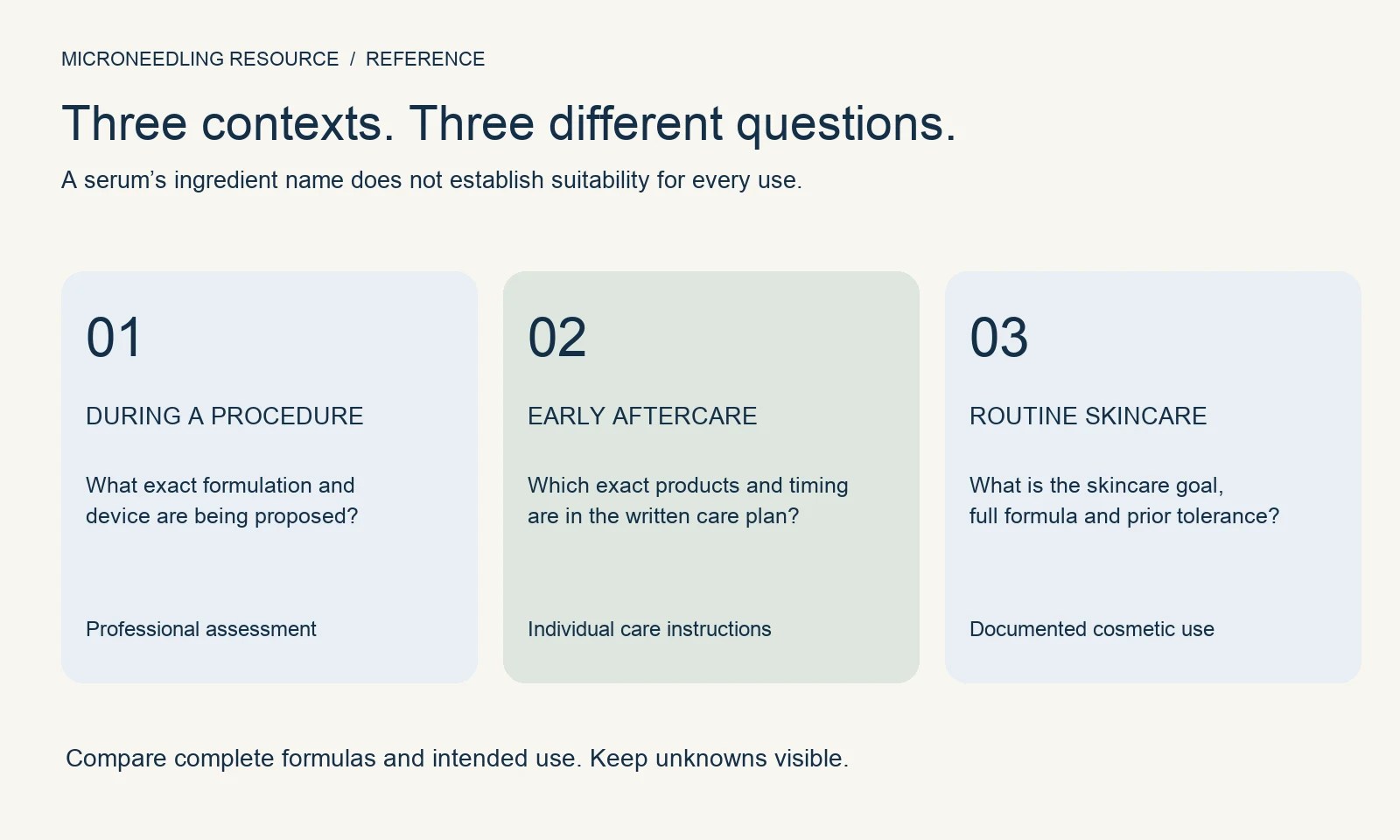
| Context | Main question | What is insufficient |
|---|---|---|
| During treatment | Is the exact device-product combination appropriate and documented? | A popular ingredient or a retailer’s claim |
| Early aftercare | What did the treating provider recommend and when? | A universal hour-by-hour routine |
| Routine skincare | Does the formula suit the goal and tolerance? | Assuming a hydration claim means scar treatment |
| Product comparison | What is independently verified versus manufacturer claimed? | A score without disclosed criteria |
The regulatory boundary
FDA information states that microneedling devices are not approved for delivery of cosmetics, medications or other topical products into skin. That matters when a serum is advertised as a way to “boost absorption.” A product’s suitability for intact skin should not be extended to an invasive route without evidence.
Read beyond the hero ingredient
Evaluate the complete INCI list, intended use, packaging, expiry, traceability and manufacturer directions. Fragrance-free, sterile, single-use and clinically tested describe different properties. None should be used as a substitute for the others. If pH or relevant testing is not disclosed, mark it unknown rather than estimating it.
Our three-context framework
Procedure → clinician-directed compatibility. Recovery → individualized care. Routine → formulation and tolerance. Keep these columns separate in every comparison.
Choose your next reference
Use the ingredient database to identify functions and cautions. The standards scorecard explains what documentation matters. Ingredient articles provide narrower context for hyaluronic acid, peptides, vitamin C and retinoids. Product comparisons assess specific documented formulas, not a category-wide promise.
Build a complete serum identity card
The featured ingredient is only one part of a serum’s identity. Save the full label and directions before comparing claims. If a formula changes, the previous evaluation should not silently carry over to the new version.
| Record or decision | What to write down |
|---|---|
| Identity | Brand, product name, market and version. |
| Composition | Full INCI, not only highlighted actives. |
| Purpose | The use described by the manufacturer. |
| Handling | Package type, opening date and labeled storage. |
| Evidence | Finished-product data versus ingredient research. |
What counts as evidence about the finished formula?
Look for a report that identifies the tested formulation, participants, use conditions and outcomes. An ingredient study can explain why an ingredient is interesting, but it does not automatically test the bottle being sold.
Keep researching
- Hyaluronic Acid for Microneedling
- Peptides for Microneedling
- What Ingredients Should You Avoid With Microneedling?
- Vitamin C and Microneedling
- Retinol and Microneedling
- Microneedling Serum Ingredient Database
- Microneedling Serum Standards: How to Evaluate a Serum
- 10 Microneedling Serums Compared: How to Choose
Sources & evidence notes
Sources checked September 27, 2026. Linked regulatory and research sources describe their own populations and procedures; they do not establish that every commercial device or serum is equivalent.

