The short answer
Mechanical microneedling creates controlled punctures that initiate a tissue-repair response. The biological explanation helps explain why visible change takes time, but it does not establish the best settings for an individual.
By Microneedling Resource · Updated September 27, 2026 · AI-assisted research and writing. This educational page has not been medically reviewed.
On this page · From puncture to remodeling · Why radiofrequency is different · Use the mechanism to ask better questions · From mechanism to meaningful outcome · Keep researching · Sources & evidence notes
| Skin concept | Role | Why it matters |
|---|---|---|
| Surface barrier | Separates the body from the environment | Disruption changes the context for topical products |
| Epidermis | Outer living skin layers | Skin reaction and pigment response require attention |
| Dermis | Connective tissue containing collagen and other structures | Procedural injury is intended to influence remodeling |
| Repair and remodeling | A sequence of biological responses | Immediate appearance and mature outcome differ |
From puncture to remodeling
The reviewed literature describes signaling after injury, including growth-factor pathways and subsequent changes in dermal tissue. This mechanism provides biological plausibility. It does not mean that creating more injury will produce a better outcome or that all treatments marketed with the same name behave similarly.
Why radiofrequency is different
RF microneedling adds delivered energy to needle penetration. The FDA has reported serious complications with certain uses, including burns and scarring. Mechanical and RF studies must be read separately. A clinic should identify which category it proposes and discuss that device’s risks and labeling.
Mechanism is not permission
An ingredient’s laboratory effect does not establish safety when introduced through a disrupted skin barrier. Evaluate the final formulation, intended route and device instructions together.
Use the mechanism to ask better questions
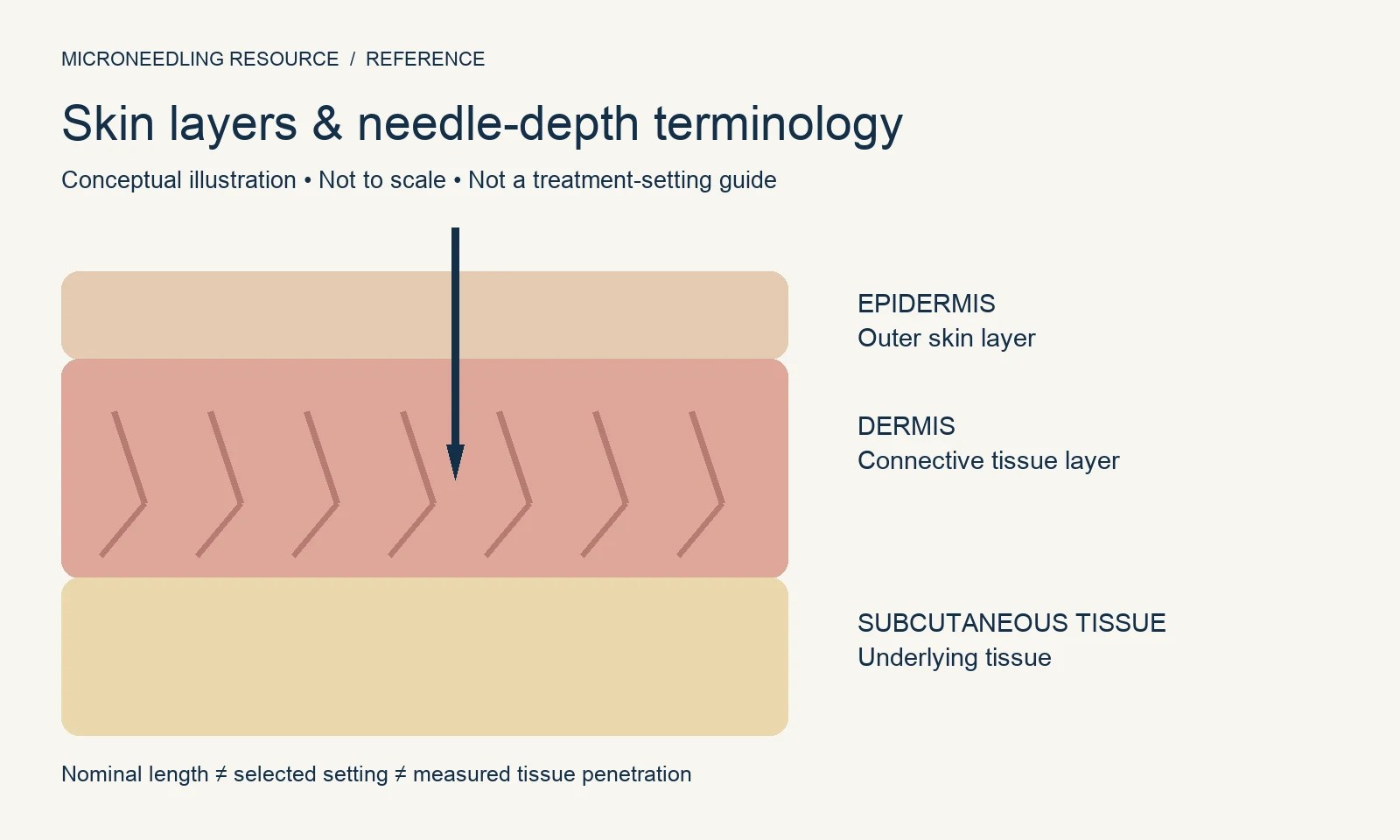
Ask what part of your concern the treatment is intended to change, how that change will be measured, and whether the evidence involved the same device category. The depth chart explains why a displayed setting is not a complete description of tissue exposure.
From mechanism to meaningful outcome
A plausible mechanism is the beginning of an explanation. It does not establish the size of a visible improvement or determine which treatment is best. Read mechanism claims alongside measured outcomes and follow-up, keeping laboratory observations distinct from patient results.
| Record or decision | What to write down |
|---|---|
| Physical event | What does the particular device do to tissue? |
| Biological response | What response does the source actually measure? |
| Visible outcome | Is there a documented change that matters to patients? |
| Durability | Was that change assessed after initial recovery? |
Does “collagen induction” tell me how much improvement to expect?
The phrase describes a proposed or observed biological process. It is not a percentage improvement, a guarantee or a comparison with other procedures. Ask for evidence about the outcome you want.
Keep researching
- What Is Microneedling? Complete Guide
- Microneedling Pen Guide
- Microneedling Needle Depth Chart & Reference Guide
- Microneedling Results: How Long Does It Take?
Sources & evidence notes
- Systematic review: potential adverse effects
- FDA: Radiofrequency microneedling safety communication
- FDA: Microneedling devices
Sources checked September 27, 2026. Linked regulatory and research sources describe their own populations and procedures; they do not establish that every commercial device or serum is equivalent.

